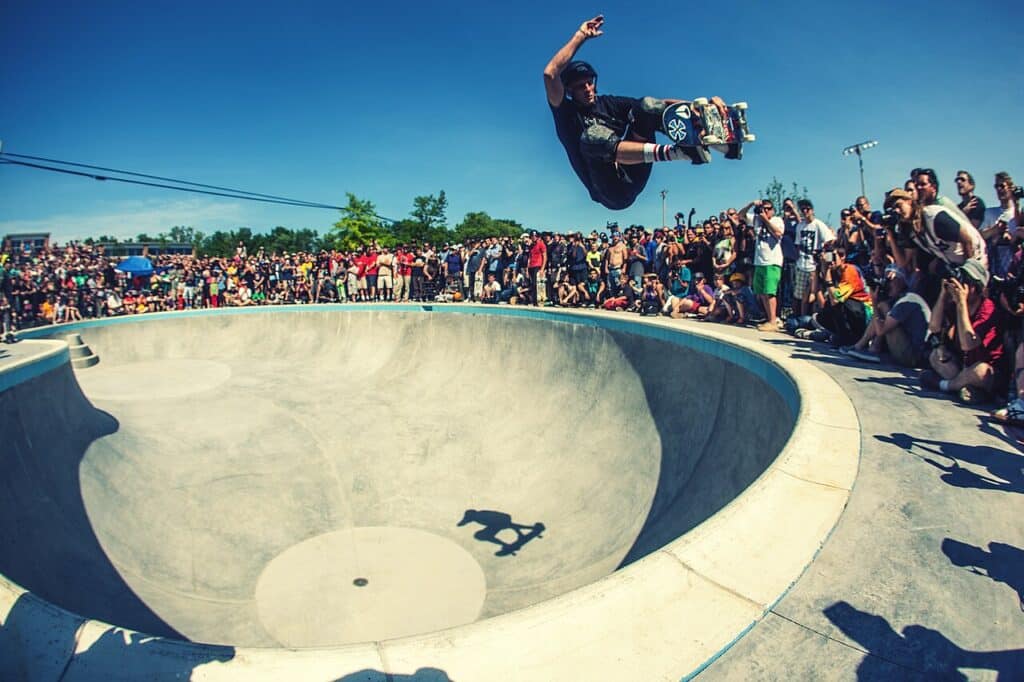
Photo by Wikimedia Commons 2.0
Having originated as an underground movement, centring on fashion, music and being able to travel with ease, the transition of skateboarding into and Olympic sport, has been a remarkable one.
Plenty of conjecture circulates about the conceptual idea of skateboarding, with a fair few different origin theories but the idea of the sport was born from surfers, who wanted to keep their surfing skills on point during low wave seasons.
Attaching roller skate wheels to wooden boards enabled surfers to replicate many moves they would make in the water, on land and it quickly became an alternative means of transport in California and beyond.
Fast forward a few decades and the professionalism surrounding skateboarding is a different world from the rebellious roots it originally forged in society back in the 1950’s and 1960’s.
The Tokyo 2020 Olympics was the first time that skateboarding had been recognised as an Olympic sport, following on from contemporaries such as BMX biking.
While the pinnacle of the skateboarding world from the outside maybe the Olympics, the X Games is another staple of the sporting calendar, which has also developed the global profile of not just skateboarding, but many other alternative and extreme sports.
Increased prominence and interest in skateboarding has been reflected in the betting sphere too, with gambling sites UK and worldwide offering a range of skateboarding betting markets.
The history of skateboarding as a sport is a short but storied one and here is a look at the journey that took it from hobby to Olympic sport:
Surfing culture
Beaches, boards and waves are three of the fundamental things people think about in the world of surfing and the link between surfing and skateboarding is inescapable.
The concept of skateboarding generated from a Californian surfing scene, who grew frustrated by a lack of waves at certain times of the year, which led them to look for alternative means to keep moving on boards.
Combining roller skate wheels, to a wooden board was seen as the way of replicating their surfing exploits and from there, skateboarding was born.
Being able to travel sideways on and perform tricks on these hybrid boards was key to the appeal of this mish-mash crossover but the vocation became relatively obscure by the 1970’s, with the unregulated world of skateboarding beset with safety issues.
Technological advancements
Starting as a relative underground movement, skateboarding quickly embraced innovation, with more streamlined boards completely changing the sport.
Moving away from many of the quirks and techniques used in the world of surfing yet still owing a nod to the link between the two sports, quickly skateboarding grew in international stature.
Tricks, flicks and board control, became more important than speed and agility and the rationale for what skateboarding would look like as a competitive sport began to take shape.
Skateparks began popping up in suburban areas in America, quickly followed by Europe and Asia and a whole movement was beginning within the skateboarding world.
Big names, big games
By the 1990’s, skateboarding had already endured many peaks and troughs within the public domain but the emergence of one skateboarding icon, changed public perception of skateboarding.
Tony Hawk heralded from California, a skateboarding hotbed and was a teen phenomenon in the state at the start of the decade, before the onset of the X Games completely changed his life.
Inaugurating in 1995, the X Games was set up to provide an international platform for the best extreme sports stars to do battle.
Skateboarding quickly became a staple of the X Games calendar, with bumper audiences tuning in to see the best in the world showcase their incredible tricks and gravity defying jumps.
This perfect storm saw Hawk clinch 16 X Games medals in an eight year period, propelling him to the forefront of the sporting world and putting skateboarding very much on the map.
With a video game named after him, music and fashion cultures embracing skateboarding in a previously unseen way, the stage was set for skateboarding to boom.
Olympics calling
The tradition of the Olympic Games and the underground nature of skateboarding don’t look like a perfect match on paper, yet skateboarding seemed on a collision course for the Olympics by the mid 2000’s.
In a short space of time, the free-wheeling X Games had become a well-polished professional event, with the athletes participating commanding huge audiences and bumper fees.
Global popularity is one of the key indicators of inclusion for the Olympic Games and skateboarding ticked plenty of boxes in that department.
The other key factor for those calling for Olympic inclusion was the youthful nature of both the sport and those who participated in it.
Much was being done by the International Olympic Committee to protect the future of the games and including sports that resonate with the next generation is key, with skateboarding fitting that bill.
History in Tokyo
Despite some reluctance in the world of skateboarding with regards Olympic inclusion, the moves were made and the boxes were ticked enabling skateboarding to be on the Olympic roster by Tokyo 2020.
Split into two competition domains: street skateboarding and park skateboarding was an instant hit at the games, with competitors battling it out to achieve the best possible score on each of their judged runs.
With teen superstars clinching medals in both the men’s and women’s events in the Japanese capital and at Paris 2024, the future looks extremely bright for skateboarding as an Olympic sport.