Image by Wikimedia Commons CC BY-SA 3.0
Alongside providing a stage for the planet’s best footballing talent to perform on, the World Cup has also platformed some of the game’s keenest tacticians and strategists over the last century.
If the players are the protagonists, then the coaches are the scriptwriters, and the greatest World Cup managers of all time have guided their teams to glory through their shrewd work on the training ground and touchline.
As part of our MansionBet.com World Cup series, we’ve taken a look at some of the tournament’s best-ever managers and those that their successors will be eager to emulate in 2026.
10. Marcello Lippi – The 2006 Maestro
Marcello Lippi was in the hotseat when Italy triumphed at World Cup 2006, a victory that was achieved during the Calciopoli scandal, when Italian football was in the grip of a match-fixing crisis.
In the face of all of that turmoil, Lippi managed to galvanise his squad, using pragmatic, yet versatile tactics to shift formations based on the opponent, the game state and what was required for a specific occasion.
Lippi had a healthy sprinkling of stardust to work with in attack, with players like Francesco Totti, Luca Toni and Alessandro Del Piero in tow, though true to their traditions, Italy’s real strength was in defence with Ballon d’Or winner Fabio Cannavaro anchoring a robust backline.
The savvy Lippi used those solid defenders as Italy’s foundation for success, with the Azzurri conceding only one goal in six games en route to the final against France, before beating Les Bleus on penalties.
Marcelo Lippi after he won the 2006 World Cup with Italy. 🇮🇹😎🚬 pic.twitter.com/nI6b7YfVKZ
— EuroFoot (@eurofootcom) November 12, 2025
9. Vicente del Bosque – The Tiki-Taka Architect
A streetwise Vicente del Bosque was clever enough to transplant Barcelona’s all-conquering tiki-taka style onto the international stage, which resulted in Spain delivering their first-ever World Cup victory in 2010.
After a shock opening loss to Switzerland, La Roja went on to win every other match under Del Bosque in South Africa, defeating the Netherlands 1-0 in the Johannesburg final, thanks to Andrés Iniesta’s famous extra-time strike.
Del Bosque’s loyalties at club level were to Real Madrid, whom he managed twice during two different spells before taking the Spanish job.
However, he was able push his ego and biases to one side to build a Spain side in Barca’s image. With a studious, possession-based, short-passing philosophy ingrained, Spain won the World Cup final with seven Barcelona players in their starting XI.
Spain’s approach would inspire a generation of imitators, with control-based football becoming widespread around the world after La Roja’s success.
8. Joachim Löw – The Possession Perfectionist
Germany finally ended their lengthy 24-year wait for a fourth World Cup in 2014 and Joachim Löw’s fluid tactical blueprint was a key elevating factor behind their triumph in Brazil.
Löw used the technically brilliant and positionally astute players at his disposal, like Bastian Schweinsteiger, Mesut Ozil, Mario Gotze, Toni Kroos and Thomas Müller, to manufacture space and create overloads against bewildered opponents.
That, coupled with Phillip Lahm’s raiding runs down the right and Miroslav Klose’s sharp finishing, made Germany a formidable prospect. Their 7-1 demolition job on Brazil in the semi-finals, in particular, proved that Löw’s tactical theorem was masterful.
Löw’s high-pressing, fluid attacking style was carried out with relentless intensity and over his 15 years at the helm, German football evolved from rigid efficiency to beautiful, easy-on-the-eye dominance.
7. Alf Ramsey – England’s Wingless Wonders
Still the only manager to ever do it, Alf Ramsey won the 1966 World Cup with England, using a disciplined 4-4-2 formation that famously dispensed with the traditional wingers seen in the country’s domestic divisions.
Dubbed the “Wingless Wonders,” the unorthodox system was designed to create more space for the likes of Martin Peters, Alan Ball, Roger Hunt, Bobby Charlton and Geoff Hurst to wreak havoc, and the somewhat controversial plan reaped dividends and then some.
Ramsey’s unerring commitment to his ideas and his legendary man management skills turned a talented group in a winning machine.
England’s 4-2 extra-time victory over West Germany in the final, sealed by Hurst’s hat-trick, remains the pinnacle of English football on the international stage.
6. Sepp Herberger – The Architect of the Miracle of Bern
Next, we roll the clocks back to the 1950s and to the Miracle of Bern. Ahead of the 1954 World Cup Final, Sepp Herberger’s West Germany were massive outsiders ahead of their clash with the “Magical Magyars” of Hungary.
This superb Hungarian collective, who attacked in waves with players like Ferenc Puskás, had been terrorising defences in the tournament hosted by Switzerland, and even hammered West Germany 8-3 in an early group stage encounter.
Yet, Herberger managed to flip the script when it mattered most. He deliberately rested key players for the game and even ensured his team wore revolutionary screw-in studs that gripped the sodden pitch better than Hungary’s, in what were rainy conditions in Bern.
Despite falling two goals behind inside ten minutes, West Germany kept their cool, stuck to Heberger’s plan and eventually rebounded to win 3-2 in a victory that laid the foundation for the country’s enduring World Cup legacy.
5. Mario Zagallo – The Only Man to Win as Player and Coach
Mario Zagallo holds a unique position in the annals of World Cup history in that he was the first person ever to win the tournament as a player (1958 & 1962) and as a manager (1970), with the latter achieved with what many regard as the greatest football team ever assembled.
Brazil’s performance in their 4-1 World Cup Final win over Italy in Mexico in 1970 is perhaps the finest overall display ever seen in the competition’s climactic contest, and it was the zenith of Zagallo’s managerial career.
The Brazilians had a collection of individual superstars that year, which included Jairzinho, Gerson, Tostão, Carlos Alberto, Clodoaldo, Rivellino and, of course, the greatest of them all, Pelé.
However, moulding those players into a cohesive team was a massive challenge in itself, and one which Zagallo managed to overcome.
Zagallo found the right balance between instruction and freedom, allowing his stars to flourish. Brazil played beautiful but highly effective football at the 1970 World Cup that still inspires today.
Aah Good Old Days Football
— SUPERB FOOTY PICS (@SuperbFootyPics) August 4, 2025
The Legendary Mario Zagallo pic.twitter.com/jHo5HiYkFs
4. Carlos Bilardo – The Tactical Visionary
Carlos Bilardo’s 1986 Argentina side combined pragmatism with guile, in a 3-5-2 formation that was constructed, in part, to give talisman Diego Maradona the freedom and support to shine, while maintaining overall defensive stability.
Argentina won six out of seven fixtures that year to lift the World Cup. Their tactical synergy, along with the siege-mentality instilled into the players by Bilardo powered them to glory.
Their quarter-final win over England, which featured Maradona’s “Hand of God” and the “Goal of the Century”, generated the most headlines, but Bilardo’s Argentina were a much better unit than many gave them credit for.
Indeed, with Bilardo still calling the shots, Argentina reached the final of the 1990 World Cup too, where they lost narrowly to West Germany (0-1). The 3-5-2 set up he pioneered and popularised influenced generations of coaches later on.
3. Franz Beckenbauer – The Kaiser on the Bench
Another member of that exclusive club, Franz Beckenbauer won the World Cup as a player in 1974 and then as a manager in 1990, with his West German side edging out Bilardo’s Argentina in the Final 36 years ago.
As a coach, Beckenbauer leaned into the same elegance and vision that he so famously displayed as a libero on the pitch, favouring fluid, attacking football that maximised the talents of players like Thomas Häßler, Lothar Matthäus and Jürgen Klinsmann.
Beckenbauer was also in charge when West Germany lost the 1986 final to Argentina, though he managed to mastermind a successful revenge mission for Die Mannschaft four years later.
Der Kaizer had a78% win-rate in World Cup matches overall, cementing his status as one of the tournament’s best ever managers.
2. Didier Deschamps – The Modern Dynasty Builder
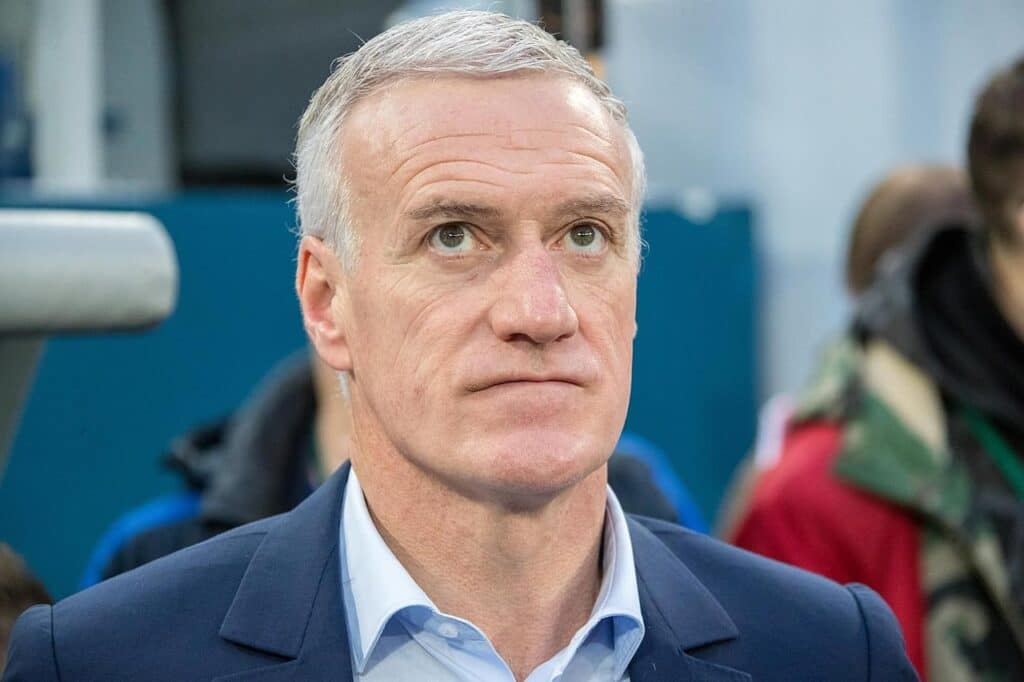
Though he still proves something of a divisive figure in his homeland, Didier Deschamps has done more for French football than most, winning the World Cup as a midfielder in 1998 and coaching Les Blues to glory in 2018.
With France’s squad routinely littered with big egos, difficult characters and clashes of personalities, Deschamps has been a peace-maker as much as anything else, though his tactical acumen is often overlooked.
Discipline has always been key for Deschamps and despite France’s enviable arsenal of attacking talent, robustness in defence has often been just as important as any sparkling play in the final third.
Deschamps came within a whisker of winning back-to-back World Cups when France were defeated by Argentina on penalty kicks in the 2022 Final in Qatar, though he will return for another bash at the title in 2026.
With one of the deepest squads in the tournament, France have been dominating World Cup 2026 betting markets, where they are many people’s pick to go all the way again.
1. Vittorio Pozzo – The Back-to-Back Pioneer
Finally, we reach the incomparable Vittorio Pozzo, a name lost in time that deserves much more recognition.
No manager has been able to match Pozzo’s feat. He won two consecutive World Cup titles with Italy in 1934 and 1938, making him the tournament’s most successful manager ever.
Pozzo’s win rate across those competitions stood at a hugely impressive 88%. The main secret of his success was the Metodo formation, a revolutionary 2-3-2-3 system that introduced a holding midfielder (the centromediano metodista) to anchor the defence, while freeing creative inside forwards to do damage further up the pitch.
The former solider was big on discipline and you can only imaging the kind of work that must have been required to convince the players to commit so completely to a system that had never been used before.
Pozzo controlled diets, enforced curfews and built psychological resilience that mirrored his time in the trenches of the First World War. This was about building camaraderie, though Pozzo was also careful to nourish football’s more creative side.
Players like Giuseppe Meazza and Silvio Piola thrived in a system that favoured short, precise passing and timing. Everything clicked for Italy in the 1930s and Pozzo’s legacy remains the gold standard for sustained international dominance.