Image by Wikimedia Commons CC BY 2.0
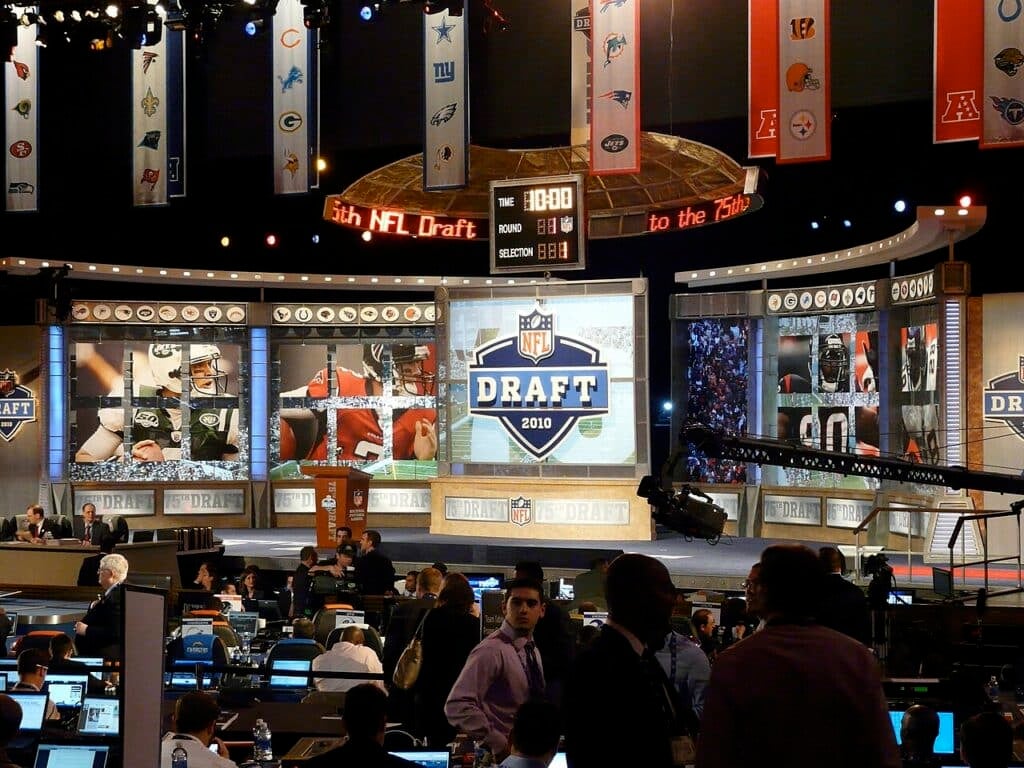
Today, the NFL Draft is a multi-billion-dollar operation that is easily one of the most anticipated sporting spectacles of the year.
It’s an event that inspires a zillion social media posts with host cities treating the Draft like the Olympics. Hot prospects arrive with expensively clad entourages to a show supported with augmented reality graphics and major fanfare.
However, it wasn’t always thus. The Draft has evolved from its origins in hushed meetings held 90 years ago in a hotel ballroom in Philadelphia into today’s glitzy extravaganza, and below we’ve plotted its journey over the decades.
The Man Who Changed Everything: Bert Bell and the Birth of the Draft (1935–1936)
Nearly a century ago, in the mid-1930s, the NFL wasn’t the sporting powerhouse that it is now. The league’s wealthier teams, like the Chicago Bears and New York Giants, were able to hoover up all of the best college talent, virtually unopposed, as smaller-market rivals struggled to attract the top prospects.
Philadelphia Eagles co-owner Bert Bell, was attached to one of those so-called “lesser “clubs and frustrated by the flow of talent to Chicago and New York, he sought out change.
At the 1935 league meetings, Bell stood up and proposed something radical. His idea involved the introduction of an annual college draft, with the weakest teams pushed to the front of the queue to pick first, in the name of fairer competition.
The owners agreed unanimously and on 8 February 1936, the first NFL Draft took place at the Ritz-Carlton Hotel in Philadelphia. This was a low-key affair, however.
There were no cameras, no live updates and no agents present. In the room, were team executives, a chalkboard and a list of the 90 college players waiting to be divvied up.
The Eagles took Heisman Trophy winner Jay Berwanger with the very first Draft pick in NFL history, though just 24 players went on to sign pro contracts.
The Road to an Historic Merger (1950s–1960s)
With the launch of the American Football League in the 1950s, suddenly, there were two separate divisions battling it out for the same college stars.
The competition between the two drove salaries skyward and forced teams from both sides of the dividing line to sharpen up their scouting. However, the split was causing real issues, so by 1966, the leagues agreed to a merger.
The common draft that followed that unification in 1967 was the first step toward a truly national talent pipeline. Scouting combines were born, centralised medical checks were introduced and the draft slowly moved from hotel ballrooms to slightly larger conference rooms.
The Revolution Will be Televised (1980)
Things stayed largely the same until the launch of ESPN in 1979, an ambitious 24-hour network that would change the entire US sporting landscape and the history of NFL draft forever.
Desperate for content to fill the airwaves, ESPN convinced NFL commissioner Peter Rozelle to let them broadcast the draft live from the Sheraton Hotel ballroom in New York on 29 April, 1980.
Nobody expected many viewers to tune in, however, millions did, instantly transforming the draft into a cultural phenomenon. That first televised draft ran for 18 hours over two days and viewership hardly dropped the entire time.
Analyst Mel Kiper Jr. joined the coverage in 1984 and turned mock drafts into a national obsession. Suddenly, football fans were imagining and re-imagining how drafts would develop all year round.
From Ballroom to Blockbuster (1990s–2010s)
Throughout the 1990s, the draft moved to bigger venues. No longer confined to hotel ballrooms, the event was hosted at Madison Square Garden, then Radio City Music Hall.
Cities even began bidding to host it as the draft’s continued popularity made it a major money spinner. In 2010, Commissioner Roger Goodell made a significant decision to move the first-round draft pick to a primetime position on a Thursday night. The draft was about to zip forward along a new vertical trajectory.
The format expanded to three days and the “road show” era began. It floated around between Chicago, Philly, Dallas, Nashville, Las Vegas and everywhere in between and besides.
In 2019, the Nashville edition drew over 600,000 fans across the draft weekend, while the combined viewership across ESPN, ABC and NFL Network topped 47.5 million. The draft had officially become bigger than most championship games in other sports.
Of course, more recently, the draft has taken flight on American football betting sites, with huge public money traded on sportsbook platforms around first picks and other niche lines. Close to $10m was wagered on the NFL draft in 2025 and that figure is expected to rise.
Why It Works? What Makes the Draft so Compelling?
The NFL Draft is a televised drama with real-life ramifications. It has all of the elements you’d expect to read in a gripping TV script.
Every team involved has their own narrative, while the futures of football’s best young players are all on the line every year. You’ve got surprise slides, blockbuster trades and emotional reactions all built in. It all makes for a deeply enthralling watch.
It’s also a source of hope. A struggling franchise can be turned around with the right quarterback acquisition in the draft, while one late-round steal can define a season.
From a fan’s perspective, all the above applies too, though the draft has also helped to build communities through engagement. The public can dissect picks, debate choices and even get involved in live betting markets if they want.
Next time you’re tuning in, remember that it all started in a Philadelphia hotel with a chalkboard and one man’s revolutionary idea.